Build a Loop with an Easy Exit
Choose a familiar running loop with clear landmarks and a straightforward way to head home early, so changing the plan feels simple rather than like a setback.

How do you choose a running route that lets you cut the run short without getting lost or having to retrace a long stretch? Start with a familiar loop, mark a few clear landmarks, and identify a shorter route home before you set off. That gives you a simple choice point if your legs feel heavy, the weather turns, or you have less time than expected.
A useful loop is not necessarily circular or scenic. It is a route whose direction you understand, whose turns are easy to recognise, and whose shorter version still brings you back calmly. You can plan it on a map, but you should also be able to describe its main turns in plain language: past the library, across the footbridge, then left at the playing field.
What makes a loop usable?
A usable loop has a clear starting point, a recognisable middle section and more than one sensible way back. The route should suit your current comfort, not an imagined future pace or distance. For a first attempt, choose roads, paths or park tracks you already know. Familiarity reduces the number of decisions you have to make while running.
Think of the route as a chain of landmarks rather than a line on a screen. A landmark is a feature you can identify reliably, such as a library entrance, a bridge, a distinctive junction or the gate to a sports ground. A tree that looks like many others is less helpful. So is a turn described only as “somewhere after the shops”.
Keep the sequence short. A compact route note might read: “Start at the community hall; follow the high street to the canal path; turn left at the footbridge; return through the park.” If you cannot remember the route without checking your phone repeatedly, simplify it or explore it on foot first.
The route need not bring you back by a different street on every outing. Reusing one familiar section can make the loop easier to follow. The important part is knowing where you can change direction and still get home without awkward detours.
How do I plan an easy exit?
Pick a point along the route where you can turn towards home using a direct, familiar path. This is your exit point. It should be an ordinary junction or landmark, not a vague stretch of road where you might hesitate about which way to go.
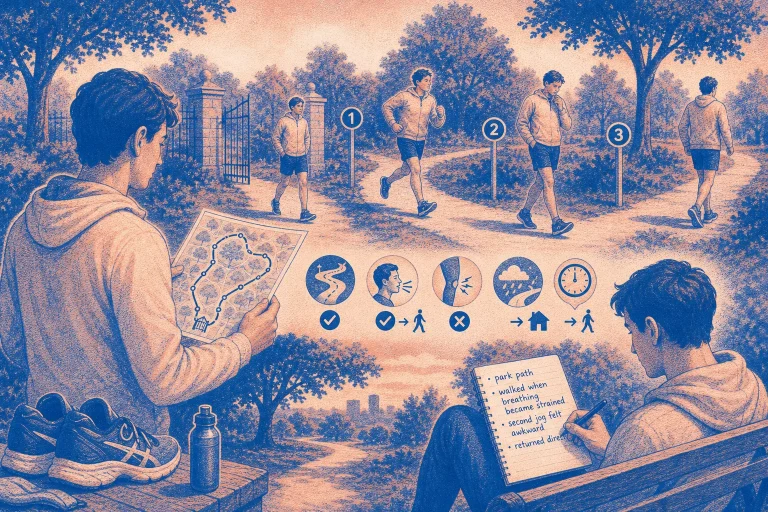
Trace two versions of the outing before leaving: the planned loop and the shorter return. For example, you might head out along a familiar residential street, reach the park gate, and continue around the park on the longer version. If you choose to shorten the run at the gate, the shorter route could follow the same street back. The decision is then clear: go through the gate for the loop, or turn back along the known way.
Make sure that the shorter option actually leads home, rather than merely avoiding one section before rejoining a longer route. A useful exit should take fewer turns and ask less of your attention. If it involves a confusing crossing or an unfamiliar path, find a simpler alternative.
For a route with several choices, name the exit points in order. You might decide to turn back at the library, take the cut-through beside the school, or continue to the canal bridge. Keep each option easy to remember. Too many branches can make a supposedly flexible plan harder to use.
Which landmarks should I choose?
Choose landmarks that are easy to spot from the direction you will be approaching. A footbridge, a large noticeboard, a public building or a marked park entrance tends to be clearer than a small sign hidden behind parked cars. If the landmark is visible only from one side, make sure that is the side your route uses.
Use landmarks to mark decisions, not every few paces. You mainly need to know where to continue, where a route changes direction and where you can head back. A handful of well-chosen points is easier to remember than a long list.
Check whether the landmark remains useful in ordinary changes of conditions. A café may be shut when you run; a bus stop may be hidden by a queue; a seasonal display may disappear. Prefer fixed features such as a bridge, a public building or a junction with a distinctive shape.
It can help to learn the route in both directions. A turn that is obvious on the way out may look different on the return. Notice what you will see when heading home, especially at crossings and park entrances. If you rely on a map app, save the route as a backup, but avoid making every turn depend on a screen.
How should I handle crossings?
Build the route around crossings you can approach and use comfortably. A signal-controlled crossing or a familiar pedestrian crossing may be easier to judge than a busy junction with several turning lanes. If a crossing feels stressful when you are walking, it is unlikely to become more convenient once you are tired.
Plan where you will wait and which direction you will take afterwards. Avoid routes that require a last-second dash, a blind turn or running along a narrow verge. Use pavements and paths where available, follow local signs, and give other people room. Running routes do not override the usual care needed around traffic, cyclists and shared paths.
Sometimes the safest route is not the shortest. A slightly longer path that uses a clear crossing can make the outing easier to manage. If you are unsure about a road or path, walk the section first or choose another route.
What if I need to turn back?
Turn back at the next planned exit point, or use the route you already know in reverse. You do not need a special reason to shorten a run. A change in comfort, attention, weather or available time is enough to choose the simpler route home.
Make the decision at a landmark rather than debating it for several minutes. At the library, for instance, you can either continue towards the park or take the familiar street back. A clear choice point keeps the route simple and lets you focus on moving safely.
Imagine you set out to follow a loop that passes the library and then circles the park. At the library, your legs feel less comfortable than expected. You turn down the familiar street instead of continuing to the park. The observable result is a shorter outing with a direct route home, rather than an uncertain detour or a forced attempt to complete the original loop.
If discomfort is sharp, worsening or unusual, stop running and take the safest way home. For a persistent concern, seek advice from a qualified health professional. A route plan is there to offer options, not to persuade you to ignore how you feel.
Should I use a map app?
A map app can help you trace a loop, check junctions and save an alternate route. Use it to prepare, then learn the route through visible landmarks. You can also write a short note or take a screenshot in case you prefer not to handle your phone while moving.
Check the route on a map before relying on it. Some maps show paths that are closed, private or unsuitable for running. Look for access signs when you arrive, and be ready to change direction if the path is blocked. If the route depends on an opening gate, a ferry or another service, check that it will be available when you plan to go.
It is not worth spending ages adjusting a digital route to produce a perfect shape. A simple out-and-back with one optional turn can serve the same purpose. The useful question is not whether the line looks elegant on a screen, but whether you can follow it and get home easily.
How can I keep the route flexible?
Give the outing a clear main route and one or two alternatives. That is usually enough. Before setting off, decide which landmark marks the turn for the shorter version and what you will do if a path is closed. Knowing these choices in advance makes it easier to adapt without treating the original plan as a commitment.
Try the route in daylight first if you are unfamiliar with it. Notice uneven surfaces, narrow sections and places where visibility is limited. If you plan to run at a different time, consider whether those details change. Choose a well-lit, familiar route when visibility is poor, and let someone know your general plan if that feels prudent.
After the outing, note any confusing turn or awkward crossing. Keep the useful parts and change the rest. A small adjustment, such as moving the exit point to a clearer junction, can make the next run easier to follow.
As you become familiar with the loop, you can decide whether to add a path or vary the return. Keep the easy exit in place. A route that offers a clear way home gives you room to make a sensible choice on the day, and that flexibility is more useful than completing a particular shape on a map.
More along this route
The Return Run After a Long Pause
A thoughtful return starts with a plan shaped around today’s circumstances, clear reasons to stop and…

What Running Shoes Need to Do on Day One
A first pair does not need to solve every running question. Check how each shoe feels…